

Updated September 2026
Off-roaders often claim that driving, or being driven in, a 4×4 on a green lane is the only way some disabled people can get out into the countryside. While this may be so for a very small number of people who have access to a 4×4, the reality is that off-roading stops most people with disabilities from enjoying green lanes on foot, by cycle, by horse and wheeling (using pushchairs and mobility devices[1], even those designed for rugged terrain).
Some examples of the effects of off-roading on disabled people are given below:
- Motor vehicle damage to the part of the Ridgeway National Trail between Overton Hill and Monkton Down means that powered mobility device users are advised that they need to be able to walk for short sections while able-bodied helpers move the device across mud and deep ruts[2]. The danger of the ruts on Monkton Down for solo mobility device users is shown in https://www.youtube.com/watch?v=m2aLaMOElC8? (from 42 seconds onwards). This part of the Ridgeway has been subject to a seasonal traffic regulation order since 2004, but this has been ineffective in making it usable by powered mobility device users.
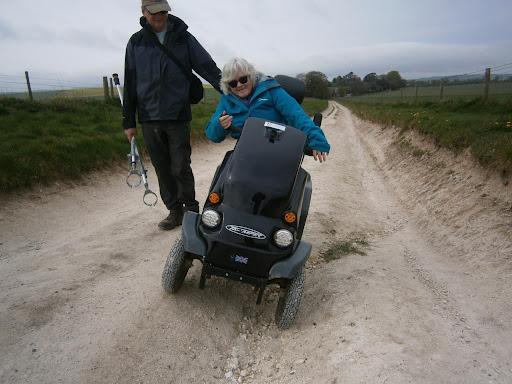
- Elsewhere in the North Wessex Downs National Landscape, the mobility device user and enthusiastic rambler in the photo below says “Even mildly rutted routes can be difficult for disabled people. Badly damaged surfaces are impossible.”
- In the Peak District a mobility device user could no longer use a green lane to access the Monsal Trail (an old railway line, so very suitable for wheeling as well as walking, cycling and horse-riding) because the surface of the green lane was so badly damaged by off-roaders. He and his wife said that even “if the surface was OK, we could not use the route because .. you would be at risk on a mobility buggy if a motor bike came fast towards you around one of the bends …There would be no time to get out of the way”[3].
- A group of walkers, including blind and learning-impaired people, was descending a green lane section of the Pennine Way National Trail, in the Yorkshire Dales, when a group of trail motorbikes came over the brow. This alarmed the walkers and the alarm was compounded when one of the riders lost control and crashed into the boundary wall, fortunately without injury to himself or the disabled party. But it demonstrated that disabled people and motor vehicles are a dangerous mix.
In stark contrast, elsewhere on the Ridgeway National Trail, sections where recreational motor vehicles are prohibited can provide safe access for the disabled. The photo below is of a group of carriage drivers over 60 years of age who were no longer able to walk, horse ride or cycle any distance. This part of the Ridgeway is now accessible for all its traditional uses.
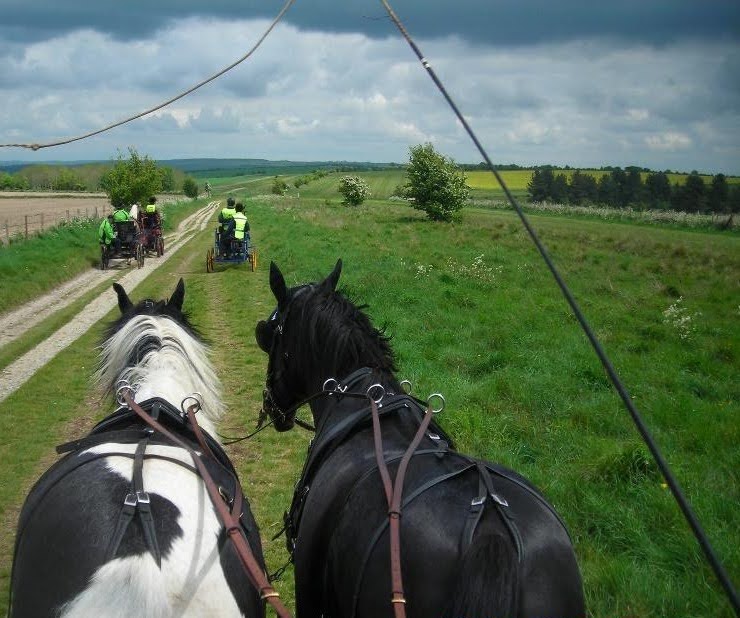
One said “I have not been up here for years because I can no longer walk or ride any distance but now the Ridgeway surface is in good condition for horse drawn carriages, I can get out into the countryside again with my horse”.
One of the organisations representing recreational motorists, GLASS, put a post on its Facebook page in October 2025 about repairs to Strata Florida, a green lane in mid-Wales; in response, a user complained that if lanes were repaired so that “mobility scooters can go down them .. we may as well not bother having capable trucks”. That is, some GLASS members want green lanes which cannot be used by mobility device users and other disabled users because they want poor surface conditions as a challenge for them and their vehicles. Such challenges belong to private sites, not highways such as green lanes. This post shows that GLASS’s claim to support disabled people’s right to use green lanes is not shared by all its members.
Walking, cycling, horse-riding, carriage-driving and wheeling on green lanes are valuable, cherished activities for people with learning disabilities, deafness, blindness or anxiety conditions. What is valued is the peace and tranquillity of the lanes. Encounters with off-roaders, or evidence of the damage they have inflicted on the green lanes, jeopardises the enjoyment, and sometimes the safety, of disabled people. The needs of people with disabilities who want to get out into the countryside are best met by green lanes free of ruts and off-roading.
Notes
1 – Mobility devices is the term the Department for Transport is using in its review of the law governing the use of ‘invalid carriages’ on highways, and of the regulatory requirements for such mobility devices – see https://www.gov.uk/government/consultations/reviewing-the-law-for-powered-mobility-devices/reviewing-the-law-for-powered-mobility-devices
2 – https://nationaltrails.s3.eu-west-2.amazonaws.com/uploads/Visiting-The-Ridgeway-as-a-physically-disabled-person-v3.pdf, pages 2 and 5.